Peer Review Process
Sustainable Trends and Business Research (STBR) is committed to maintaining the highest standards of scholarly evaluation through a rigorous, transparent, and ethically governed peer review process. Peer review serves as the cornerstone of academic quality assurance and is essential for preserving the integrity, reliability, and credibility of the published scholarly record. All manuscripts that successfully pass initial editorial screening enter the formal peer review process.
STBR operates a double-anonymized peer review system. Under this model, the identities of authors and reviewers are concealed from one another throughout the evaluation process. This approach is designed to minimize bias and ensure impartial assessment based solely on academic merit. Authors are required to submit manuscripts that are fully anonymized. Identifying information — including author names, institutional affiliations, acknowledgements, funding identifiers that reveal institutional identity, and self-referencing language — must be removed from the manuscript file. Any metadata embedded within the document file must also be cleared prior to submission. If anonymization requirements are not met, the manuscript will be returned to the authors for correction before entering peer review. Reviewers are instructed not to disclose their identities within their reports or communications.
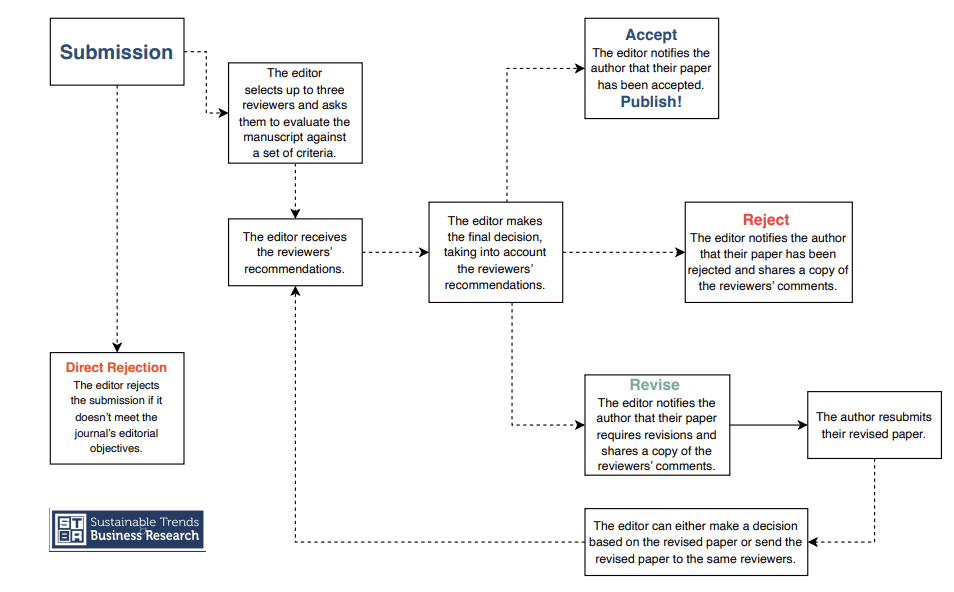
The Editor-in-Chief, or a designated handling editor, oversees the peer review process. Editorial responsibility includes reviewer selection, evaluation of reviewer reports, and issuance of final decisions. Each manuscript deemed suitable for review is assigned to a minimum of two independent expert reviewers with demonstrated expertise in the subject area of the submission. Reviewer selection is based on:
- Academic qualifications and research background;
- Publication record in relevant fields;
- Prior experience in peer review;
- Absence of conflicts of interest.
Editors carefully assess potential reviewer conflicts, including institutional affiliation, collaborative history, financial relationships, or other connections that may compromise objectivity. Editors and reviewers must declare any actual or potential conflicts of interest. Where a conflict exists, the individual must recuse themselves from the evaluation process. The editorial team retains full authority over reviewer assignment and may seek additional expert opinions when necessary.
Reviewers are asked to assess manuscripts according to clearly defined scholarly criteria. Evaluation typically considers:
- Originality and novelty of the contribution;
- Relevance to the journal’s disciplinary scope;
- Theoretical and conceptual robustness;
- Methodological appropriateness and rigor;
- Validity and reliability of data and analysis;
- Strength and clarity of argumentation;
- Contribution to existing literature;
- Practical, managerial, or policy implications where applicable;
- Quality of writing and structure.
Reviewers are required to provide constructive, evidence-based feedback that supports academic improvement. Personal criticism or unsubstantiated claims are not acceptable. The journal encourages reviewers to recommend specific improvements where weaknesses are identified.
Upon receipt of reviewer reports, the Editor-in-Chief or handling editor evaluates the recommendations alongside independent editorial judgment.
Possible editorial decisions include:
- Acceptance without revision;
- Minor revision;
- Major revision;
- Rejection.
Most manuscripts undergo at least one round of revision before a final decision is reached.
Reviewer recommendations are advisory. The final decision rests exclusively with the Editor-in-Chief. In cases where reviewer opinions conflict significantly, the editor may:
- Seek an additional independent review;
- Conduct an independent evaluation;
- Request clarification from reviewers.
Editorial decisions are based solely on scholarly merit, methodological soundness, and alignment with journal scope. Commercial considerations, sponsorship arrangements, advertising interests, or external pressures do not influence editorial outcomes.
When revisions are requested, authors must submit:
- A revised manuscript;
- A detailed response document addressing each reviewer comment;
- Clear identification of changes made within the manuscript.
Authors are expected to respond respectfully and substantively to reviewer feedback. Where authors disagree with a comment, they must provide a reasoned academic justification. Revised manuscripts may be returned to the original reviewers for further assessment, particularly in cases of major revision. Failure to adequately address reviewer comments may result in rejection.
While timelines may vary depending on reviewer availability and manuscript complexity, the journal aims to communicate a first decision within approximately 6–8 weeks of submission. Authors may monitor the status of their manuscript through the OJS submission system. All official communication is conducted through the journal’s editorial platform and registered email channels. The journal does not guarantee accelerated review and does not provide preferential treatment based on institutional affiliation, geographic location, or funding status.
Authors who believe a decision was based on a significant academic misunderstanding may submit a formal appeal. Appeals must include a detailed explanation supported by scholarly argumentation and evidence. Appeals are evaluated independently by the Editor-in-Chief and, where appropriate, additional editorial board members not involved in the original review process. The outcome of the appeal process is final. Complaints regarding reviewer conduct, editorial behavior, or procedural irregularities are handled confidentially and investigated in accordance with the journal’s Publication Ethics & Editorial Policies.
The peer review process is conducted in alignment with internationally recognized principles of publication ethics.
Reviewers are required to:
- Maintain strict confidentiality;
- Use manuscript content solely for review purposes;
- Provide objective and impartial evaluation;
- Avoid personal criticism;
- Disclose conflicts of interest;
- Refrain from using unpublished information for personal or professional advantage.
Editors reserve the right to investigate allegations of bias, misconduct, or unethical behavior within the review process. Where necessary, corrective action will be taken to preserve the integrity of the scholarly record.
To enhance transparency and provide authors with a clear understanding of the evaluation stages, the flowchart below presents the complete peer review workflow adopted by STBR, from initial submission to final publication.